Thermal Remediation Review for GTA Bed Bug Jobs

A thermal remediation review should answer one question before anything else: do you need to heat your entire home, or only the rooms where bed bugs are actually hiding? For many GTA households, that difference can mean thousands of dollars, a full day of disruption, and unnecessary risk to belongings.
Whole-home heat treatment can work when it is planned and performed correctly. But it is not automatically the smartest answer to every infestation. Bed bugs do not care how much you spend. They care whether the treatment reaches their hiding places, maintains lethal temperatures long enough, and includes a plan to catch any activity that remains.
Thermal Remediation Review: What Whole-Home Heat Actually Does
Traditional thermal remediation raises the temperature across an entire house, apartment, or unit to a level that kills bed bugs and their eggs. Technicians use industrial heaters, fans, sensors, and monitoring equipment to bring air, furniture, wall voids, and other harbourage areas up to treatment temperature.
The appeal is obvious. Heat can kill bed bugs at every life stage without relying on a broad pesticide application. A properly executed heat treatment may also produce fast results, often within a single treatment day.
The problem is that a whole-property approach treats every room as though it has the same level of infestation. If activity is limited to one bedroom, a sofa, or a small number of connected areas, heating the full property may be more treatment than the situation requires.
That does not mean whole-home heat is always a poor choice. In a heavily infested home, a multi-unit setting with widespread activity, or a property where bed bugs have travelled through several rooms, broader thermal treatment may be justified. The right method depends on confirmed evidence, not fear or guesswork.
Heat only works when it reaches the bugs
A room feeling hot is not proof that treatment was successful. Bed bugs can hide behind baseboards, inside furniture joints, around electrical outlets, beneath flooring edges, and in clutter. Effective thermal work requires temperature sensors in the right places, steady heat circulation, and trained technicians who know where cold spots can develop.
This is why an inspection matters before any quote. Without locating the likely harbourage areas, a company may recommend the biggest treatment package instead of the most precise one.
The Real Benefits of Thermal Treatment
Heat remains one of the strongest tools in professional bed bug control because it acts quickly and can kill both live insects and eggs. It is especially useful when residents need a rapid solution or want to reduce their reliance on conventional chemical treatment.
It can also be a practical choice for certain furniture items that cannot be easily discarded. Mattresses, upholstered chairs, bed frames, and stored belongings can sometimes be treated in place when the technician can safely bring the target area to the required temperature.
For Toronto renters, homeowners, and landlords, the main advantage is speed. Nobody wants to sleep around an active infestation while waiting through repeated cycles of ineffective spray treatments. When heat is used strategically, it can shorten the path to relief.
But speed is only valuable when it is paired with verification. A treatment should include clear preparation instructions, monitoring, follow-up, and a guarantee that gives you confidence after the technicians leave.
Where Whole-Home Heat Can Fall Short
Full-home heat is often sold as a one-size-fits-all solution. It is powerful, but it comes with trade-offs that deserve a clear explanation before you commit.
First, it can be expensive. Heating every room requires more equipment, more setup, more monitoring, and more labour than treating a confirmed infestation zone. If bed bugs are isolated, homeowners may pay for capacity they do not need.
Second, preparation can be demanding. Residents may need to remove heat-sensitive items, plants, pets, medications, candles, aerosols, cosmetics, electronics, vinyl goods, and other belongings that could be damaged. Depending on the property, you may also need to move furniture away from walls and make rooms accessible for airflow.
Third, extreme heat is not risk-free. A qualified provider will assess the home and provide detailed preparation requirements, but full-property heating still places every room, item, and material under stress. This matters in condos, older homes, rooms with delicate belongings, and properties where access or ventilation is limited.
Finally, heat alone does not solve the reason bed bugs entered the home. In apartments and condos, adjacent units, shared walls, frequent visitors, and untreated neighbouring activity can all create a reinfestation risk. A good provider talks about prevention and monitoring instead of promising that one hot day fixes every future problem.
Targeted Heat Treatment: A Smarter Fit for Many GTA Homes
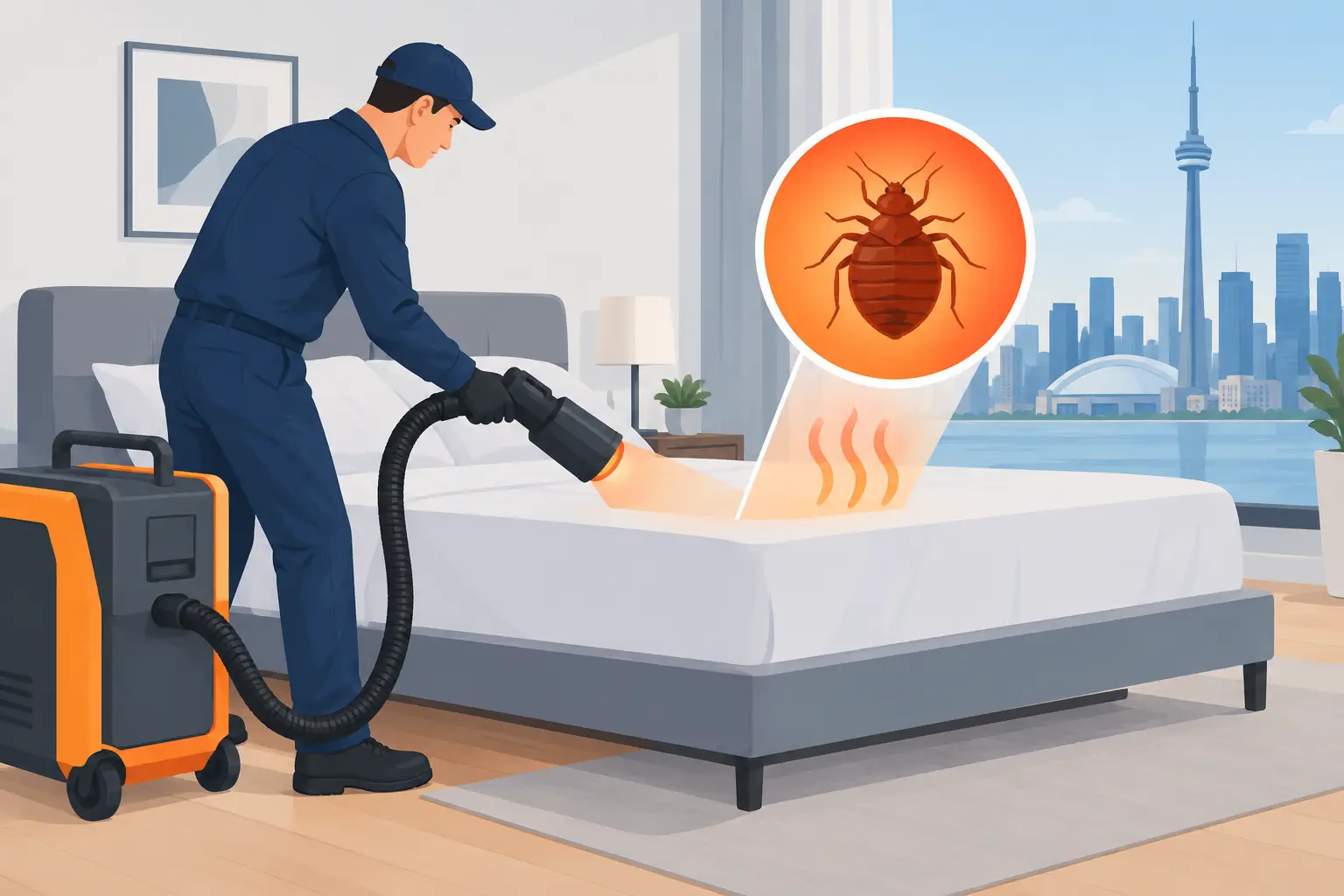
Targeted heat treatment focuses on the rooms and items where trained inspection has confirmed bed bug activity. Rather than heating an entire property, the technician treats the infested zone with controlled equipment and combines heat with detailed inspection and targeted measures where needed.
This approach is not about cutting corners. It is about matching the treatment to the evidence. When bed bugs are found in a bedroom and there is no sign of activity elsewhere, a focused treatment can reduce disruption, protect more belongings, and lower the overall cost.
For many households, that is the practical middle ground: professional heat where it counts, not unnecessary heat everywhere. Pestifight uses AI-guided detection to help identify active areas before treatment, then builds a focused plan around the confirmed infestation. This precision-led model is designed to deliver up to 50% savings compared with broad whole-home heat in suitable cases.
A targeted approach is not suitable for every property. If inspection shows activity in multiple rooms, widespread signs, or a high-risk multi-unit situation, broader treatment may be the better investment. The goal is not to sell the smallest job. The goal is to eliminate the infestation without making your home and budget absorb more disruption than necessary.
What to Ask Before Booking Bed Bug Heat Treatment
The best thermal remediation review is one you conduct before signing an agreement. Ask how the company confirmed bed bugs, whether the quote is based on visible evidence or assumptions, and which rooms will be treated.
You should also ask how temperatures are monitored, what happens if a room does not reach the required level, and whether follow-up inspection is included. A vague answer such as “we heat everything” is not a treatment plan.
Get clear information about preparation. Know what must leave the home, what can stay, how long you will be out of the property, and whether you need to bag, wash, dry, or isolate specific items. Preparation is not just an inconvenience. It affects treatment quality.
Ask about the guarantee in writing. Guarantees vary, and the details matter. Find out how long coverage lasts, what signs qualify for service, and what you should do if you see a suspected bed bug after treatment. A provider that stands behind its work should explain this without hesitation.
Finally, make sure the company is licensed and insured. Bed bug treatment involves your home, your belongings, and your peace of mind. This is not the place to choose a provider based only on the lowest price or the fastest promise.
The Cost Question: Cheap, Expensive, or Properly Scoped?
The cheapest quote is not always the best value, and the highest quote is not automatically the most thorough. The right price reflects the size of the confirmed infestation, the type of property, the number of affected rooms, preparation needs, treatment method, follow-up, and guarantee.
A full-home heat quote may make sense if bed bugs are established throughout the property. However, if no one has inspected the unit carefully or identified activity outside one room, it is fair to ask why full-property treatment is necessary.
A precise quote should feel specific. It should explain what will be treated, why that scope is recommended, what results to expect, and what happens next. That is the difference between paying for a solution and paying for a large machine to run in your home.
Bed bugs multiply quickly and spread easily through bedrooms, living areas, luggage, clothing, and neighbouring units. If you are seeing bites, dark spotting, shed skins, live insects, or unexplained activity around the bed, arrange a professional inspection quickly. The earlier the infestation is confirmed, the more options you may have to treat it precisely, protect your belongings, and get your home back under control.


Comments